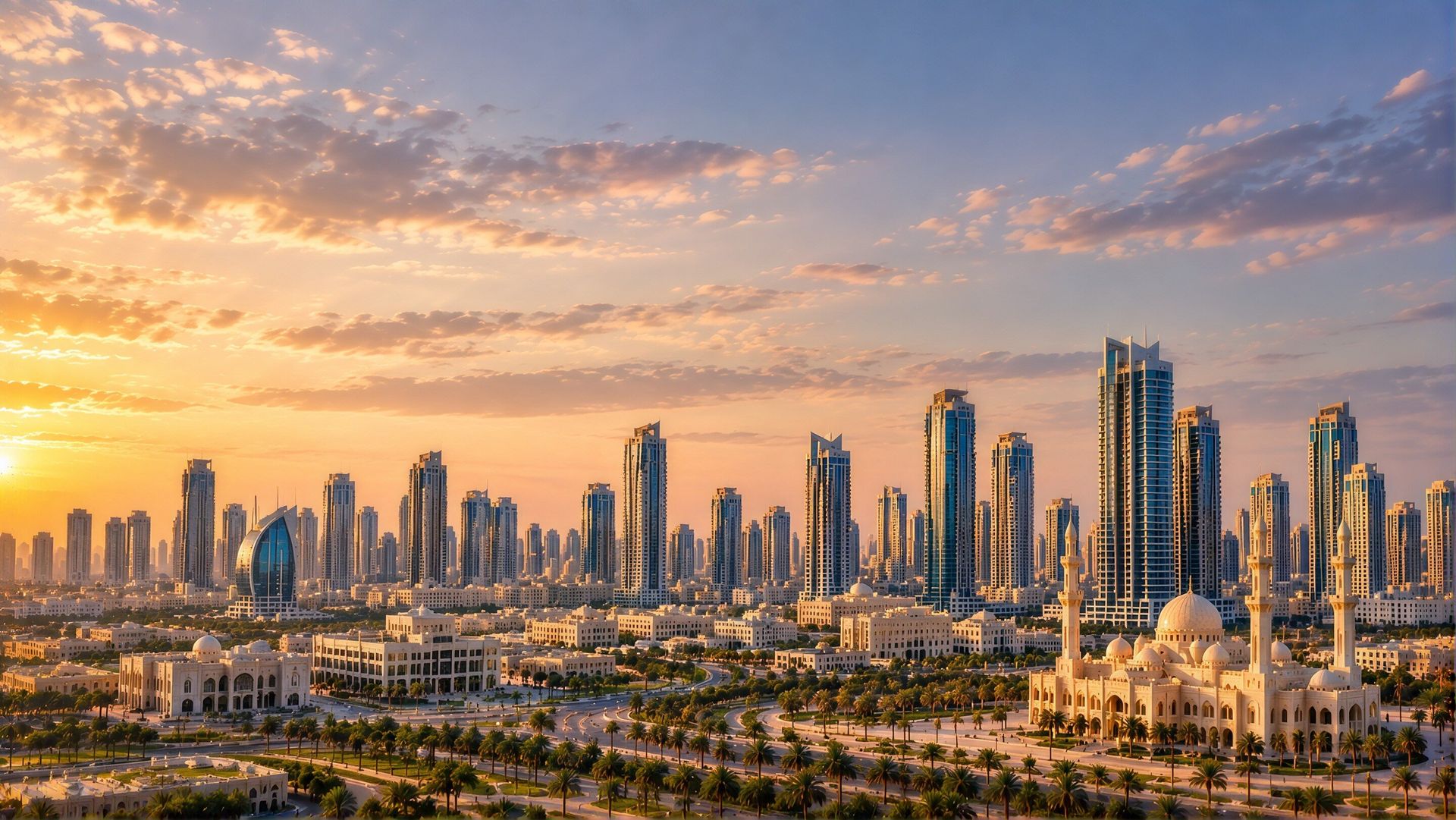
Get a cost-effective Sharjah business setup with 100% foreign ownership, flexible licences and strategic connectivity across the UAE.
and many more...
Get expert guidance
Reply in 1 hour · No spam · No obligation
Reply in 1 hour · No spam · No obligation
Why Start in a Sharjah Free Zone?
Learn more
15K+ Companies in SAIF & Hamriyah
160+ Countries Connected
30M+ Sq. M. Industrial Infrastructure
45% Growth in FDI Projects
15K+ Companies in SAIF & Hamriyah
160+ Countries Connected
30M+ Sq. M. Industrial Infrastructure
45% Growth in FDI Projects
Sharjah - Built to Make Business Easier
1 Hour
SAIF licence setup
2000+
Business activities
100%
Remote setup options
75K+
Sharjah Chamber members
19.5M
Annual airport passengers
5+
Specialised free zones
Get a setup plan tailored to your business
Which Sharjah Free Zone Fits Your Business?
Select an industry
Select an industry to view recommended Free Zones for you
No preferred Free Zone · Fair prices · 0% service fee.
We recommend what fits your business, not what pays us more.
myHQ promise
Your roadmap to launching your Sharjah business
Start here Week 4
1
Tell us what you're building, where you plan to sell and what facilities you need. We match your activity with the right Sharjah free zone and package.
myHQ handles for you
2
Share your preferred names and shareholder details. We handle name availability, legal structure and initial approvals.
You approve
3
We prepare and submit the application with shareholder documents, corporate documents and any activity-specific approvals required.
myHQ handles for you
4
The authority reviews the application and issues your licence. Some authorities advertise significantly faster timelines for eligible applications but they can change over time.
myHQ handles for you
5
We coordinate your establishment card, visa, medical, biometrics and Emirates ID. Physical UAE presence is required for the relevant in-country immigration steps.
myHQ handles for you
Week 4
Your business is live
Trade legally from UAELicense issuedBank account ready
Start here
1
Tell us what you're building, where you plan to sell and what facilities you need. We match your activity with the right Sharjah free zone and package.
myHQ handles for you
2
Share your preferred names and shareholder details. We handle name availability, legal structure and initial approvals.
You approve
3
We prepare and submit the application with shareholder documents, corporate documents and any activity-specific approvals required.
myHQ handles for you
4
The authority reviews the application and issues your licence. Some authorities advertise significantly faster timelines for eligible applications but they can change over time.
myHQ handles for you
5
We coordinate your establishment card, visa, medical, biometrics and Emirates ID. Physical UAE presence is required for the relevant in-country immigration steps.
myHQ handles for you
Week 4
Your business is live
Trade legally from UAELicense issuedBank account ready
5+ Specialised Freezones
One Setup Partner
Free Zone or Mainland? Start with where you sell.
Lean Setup Costs
Sharjah Freezones From AED 5,750 per year Lean Setup Costs
Sharjah's free zones aren't interchangeable.The right choice comes down to your activity, infrastructure needs, visa requirements and where you plan to operate.
You run a specialised business.
You want 100% foreign ownership.
Your clients are mostly international.
Full access
Sharjah Mainland From AED 12,000 per year Full access
Don't compare licences. Compare the whole setup.Look at your office, visas, approvals, warehousing, logistics and renewal costs before deciding which Sharjah free zone is actually better.
Why choose myHQ by ANAROCK?
2000+
Companies Registered
95%+
Approval Rate
0%
Service Fee
1 Hour
Response Time
India x UAE
Approval Support
Backed by ANAROCK - India’s Largest Real Estate Company
Your Sharjah free zone setup options
Best ForSolo founders, SMEsShareholders1DocumentationMediumGovernanceStandardIdeal Free ZonesSAIF · Shams · SPC
Best ForExisting UAE / international companiesShareholdersParent companyDocumentationHigherGovernanceParent-company governedIdeal Free ZonesSAIF · Hamriyah · Shams
Best ForCo-founders, partnersShareholders2+DocumentationMediumGovernanceStandardIdeal Free ZonesSAIF · Hamriyah · SPC
Best ForInvestments & asset ownershipShareholdersStructure-dependentDocumentationStructure-dependentGovernanceStructure-specificIdeal Free ZonesAuthority-dependent
Not sure which structure fits?
An expert picks it for you in one call. Free, and you're not signing anything.
Only International invoicing, Operating remotely
Documents includedLicenceVisa-OfficeFlexi-deskBank accountDigital bank account opening only
Full-fledged setup, Residency Visa for Shareholder, Hiring Local Team
We had a trade name conflict with an existing DET business. myHQ suggested three alternatives the same day and we were approved within 48 hours. The process I thought would take weeks took 3 days.
PS
Priya Singh
Founder of Management Consulting Firm
Frequently Asked Questions
How much does a Sharjah free zone license cost?
SHAMS Free Zone starts around AED 5,750/year for a professional or e-commerce license, the lowest genuine government free zone cost in the UAE. Hamriyah and SAIF Zone typically run AED 11,000–18,000/year given their industrial and logistics infrastructure, and Sharjah Publishing City falls around AED 9,000–14,000/year.
What is SHAMS free zone in Sharjah?
SHAMS (Sharjah Media City) is Sharjah's flagship free zone, purpose-built for professional, media and e-commerce activities. Most SHAMS license types don't require a physical office, which is why it consistently ranks as one of the UAE's most cost-efficient company registrations.
What free zones are in Sharjah besides SHAMS?
Sharjah has three other free zones: Hamriyah Free Zone for industrial and port-based trade, SAIF Zone (Sharjah Airport International Free Zone) for logistics and air cargo, and Sharjah Publishing City, the world's only free zone dedicated exclusively to publishing.
How much does business setup in Sharjah free zone actually cost all-in?
A single-shareholder SHAMS license with no visa typically totals AED 5,750–8,000 for the first year. Adding one investor visa pushes the total to roughly AED 10,500–16,000, and Hamriyah or SAIF Zone setups with an office or industrial plot generally start higher, around AED 15,000–22,000 all-in.
Can I set up a Sharjah free zone company without visiting the UAE?
Yes, for most license types across all 4 zones. Documents are couriered and digitally signed, with a UAE visit typically only required for Emirates ID biometrics if applying for a residence visa.
How many visas can I get with a Sharjah freezone company?
Visa allocation is tied to your office or flexi-desk package, typically ranging from 1 visa on a no-office SHAMS package up to 6 visas on larger Hamriyah or SAIF Zone office packages.
Which Sharjah free zone is cheapest?
SHAMS is consistently the cheapest, starting around AED 5,750/year, largely because most SHAMS license types don't require a physical office — the single biggest cost driver at Hamriyah, SAIF Zone or a Sharjah mainland setup.
Can Indian founders set up a company in a Sharjah free zone?
Yes. Indian founders commonly register across all 4 zones, typically needing apostilled board resolutions and FEMA-compliant reporting confirmed with their CA before incorporation, along with document attestation that myHQ coordinates as a standard part of setup.
Dream it.Plan it.Build it in Sharjah.
Start your free zone setup
No fees, no obligations. Just expert advice
Reply in 1 hourNo spam
Sharjah Free Zone Company Setup: Complete Guide (2026)
myHQ sets up companies across five free zones in Sharjah: SPC (Sharjah Publishing City), SHAMS (Sharjah Media City), Hamriyah Free Zone, SAIF Zone (Sharjah Airport International Free Zone) and SRTIP (Sharjah Research Technology and Innovation Park). Unlike Dubai’s 40+ largely general-purpose zones, each is built around a distinct sector: SPC for publishing and content, the only free zone in the world built exclusively for that industry; SHAMS for professional, media and e-commerce activities; Hamriyah for industrial and port-based trade; SAIF Zone for logistics and air cargo; and SRTIP for applied research and deep-tech.
Sharjah has become an increasingly common entry point for founders setting up remotely, largely because SHAMS and SPC remove the two biggest practical barriers to acting on a UAE company decision: a mandatory office lease and mandatory UAE travel. Hamriyah and SAIF Zone serve a different need entirely, giving trading and logistics founders seaport and airport infrastructure on GCC-India trade lanes.
What is SPC Free Zone? Sharjah Publishing City Explained
SPC Free Zone, formally Sharjah Publishing City, is the only free zone in the world built exclusively for the publishing industry, with an activity list and licensing structure designed around the publishing value chain rather than adapted from a general commercial framework.
Its permitted activities cover book and periodical publishing, content licensing and rights management, printing-adjacent services, and media production. That combination does not exist at any other Sharjah zone, or at any free zone in Dubai or Abu Dhabi.
The SPC Publishing Permit
SPC’s distinguishing feature is its Publishing Permit, which lets individual authors and small publishers register without forming a full company. For solo publishing professionals, it is the simplest and lowest-cost entry point among Sharjah’s free zones, and there is no equivalent at SHAMS, Hamriyah or SAIF Zone.
Who SPC Suits
Publishing houses, independent authors, content licensing businesses, rights management operations and media production companies. Founders in these categories should look at SPC before SHAMS, since SHAMS’ professional and media licence categories cover general content work but not the publishing value chain with the same regulatory precision. SPC operates on a flexi-desk-friendly model similar to SHAMS, with licences typically issued within 3 to 5 working days.
What is SHAMS Free Zone? Sharjah Media City Explained
SHAMS Free Zone, formally Sharjah Media City, is Sharjah’s flagship free zone for professional services, media and e-commerce businesses, built on a deliberately low-friction, low-cost registration model.
Most SHAMS licence types, including professional, e-commerce and media categories, do not require a physical office. A flexi-desk or virtual address package satisfies the requirement instead. That single structural choice is the main reason SHAMS consistently ranks among the most cost-efficient company registrations in the UAE, starting around AED 5,750/year.
The SHAMS activity list spans consulting, information technology (IT) services, marketing, digital content, e-commerce and general professional services, making it the default choice for solo founders, freelancers moving into a corporate structure, and small consulting or agency businesses with no need for a UAE-based physical footprint. Founders wanting the zone-specific detail can read our SHAMS company formation guide.
Who Should Set Up in a Sharjah Free Zone?
IT consultants, digital marketing agencies, freelance professionals and remote-run service businesses are the clearest fit for SHAMS, given its no-office requirement and low entry cost. E-commerce founders, particularly direct-to-consumer brands and dropshipping operators, are a fast-growing SHAMS segment for the same reason: a dedicated e-commerce licence without warehouse obligations, so a founder can begin invoicing international or GCC customers using third-party fulfilment instead of UAE-based storage.
Publishing houses, independent authors, content licensing businesses and media production companies belong at SPC.
Import/export and general trading businesses, especially those moving containerised or bulk cargo through GCC-India or GCC-Africa lanes, are better served by Hamriyah Free Zone, which sits directly on Sharjah’s seaport infrastructure. Logistics operators, freight forwarders and businesses needing fast customs clearance for air-shipped goods fit SAIF Zone, positioned next to Sharjah International Airport’s cargo terminal. For trading businesses moving physical goods, both offer shorter customs clearance times and lower logistics overhead than routing similarly sized operations through Dubai’s more congested ports and airport.
Research-led and deep-tech founders with university or lab partnership needs fit SRTIP.
Sharjah Free Zone Licence Types
Zone
Licence Type
Covers
SHAMS
Professional Licence
Consulting, IT services, marketing and other service-based activities. SHAMS’ most commonly issued category, and the one driving its cost-efficiency reputation since it rarely requires a physical office.
SHAMS
E-commerce Licence
Online-only retail and marketplace selling, permitting operation without a warehouse or physical shopfront, which keeps annual costs meaningfully below a commercial trading licence carrying warehouse obligations.
SPC
Media Licence and Publishing Permit
Media Licence covers publishing, content licensing and media production. Publishing Permit covers individual authors and small publishers who don’t need a full company structure.
Hamriyah
Industrial Licence
Manufacturing, assembly, processing and packaging, typically paired with industrial land or warehouse allocation given the physical nature of these activities.
SAIF Zone
Trading and Logistics Licence
General trading, freight forwarding and logistics activities, generally issued with flexi-desk or small office packages rather than industrial land.
Company Formation in a Sharjah Free Zone: Step by Step
Step 1: Choose Your Zone and Activity
Match your business activity to SHAMS (professional, media, e-commerce), SPC (publishing and content), Hamriyah (industrial and port trade), SAIF Zone (logistics and air cargo) or SRTIP (research and deep-tech). This decision also determines your licence category and whether physical space allocation applies.
Step 2: Reserve Your Trade Name
Your chosen zone authority checks your proposed company name against naming conventions and reserves it for your application.
Step 3: Submit Incorporation Documents
This includes passport copies of all shareholders, passport-size photographs, a completed application form and, for Indian founders, apostilled copies of supporting documents where the authority requires them. myHQ coordinates apostille as part of this step rather than as a downstream surprise.
Step 4: Pay Licence Fees and Receive Your Trade Licence
Once documents are approved, the government fee is paid and your Sharjah free zone trade licence, establishment card and digital incorporation documents are issued. SHAMS and SPC licences are typically issued within 3 to 5 working days; Hamriyah and SAIF Zone can run 4 to 6 working days where industrial plot or larger office allocation is involved.
Step 5: Apply for Visas and Open a Corporate Bank Account
With your trade licence issued, you can apply for an investor or employee residence visa, complete Emirates ID registration and begin corporate bank account opening. This is typically the longest single step, running 2 to 6 weeks depending on the bank and your Know Your Customer (KYC) documentation.
Sharjah Free Zone Licence Cost: Full Breakdown (2026)
Sharjah free zone licence cost varies by roughly three times across the zones, driven almost entirely by whether physical space is required.
Cost Component
SHAMS
SPC
Hamriyah
SAIF Zone
Licence fee (single activity)
AED 5,750–8,500/year
AED 7,500–11,000/year
AED 9,000–13,000/year
AED 10,000–14,000/year
Office/flexi-desk requirement
Not required for most activities (flexi-desk optional AED 2,000–4,000/year)
A single-shareholder, no-visa SHAMS professional licence, the most common Sharjah free zone entry point, typically lands around AED 5,750 to 8,000 all-in for the first year. A comparable no-visa setup at SPC runs AED 9,000 to 13,500. Hamriyah and SAIF Zone generally start higher given their office or industrial plot requirements: AED 13,000 to 19,000 for a no-visa Hamriyah setup, and AED 14,000 to 20,000 for SAIF Zone. SRTIP pricing is activity-dependent and quoted on request.
SHAMS’ no-office model is what makes it categorically cheaper than the other zones, not a difference in government fee structure alone.
Which Sharjah Free Zone Should You Choose?
If your business…
Choose
Because
Needs no physical footprint (consulting, IT, marketing, e-commerce)
SHAMS Free Zone
No office requirement, lowest entry cost
Is in publishing, content licensing or rights management
SPC Free Zone
Only zone with a publishing-specific activity list and Publishing Permit
Moves containerised or bulk cargo by sea
Hamriyah Free Zone
Direct seaport access, industrial land and warehousing
Moves time-sensitive or lower-volume goods by air
SAIF Zone
Airport-adjacent cargo facilities, fast customs clearance
Is research-led or deep-tech
SRTIP
University and lab partnerships
The deciding factor is rarely price. A founder choosing between SHAMS and Hamriyah on cost alone is usually asking the wrong question; the right question is whether the business needs a warehouse. Similarly, a founder running meaningful air cargo volume should default to SAIF Zone regardless of the cost difference, since a Hamriyah registration doesn’t meaningfully help an air-cargo-dependent business. Between SHAMS and SPC, both share a low-office, flexi-desk-friendly cost profile, so the deciding factor is activity fit: SHAMS covers general consulting and content work, while SPC is built specifically for publishing, content licensing and rights management.
UAE Visa Options Through a Sharjah Free Zone Company
Sharjah free zone companies can sponsor several visa types:
Investor visa: typically 2-year validity, tied to shareholding and licence
Employee visa: tied to your office or flexi-desk package and licence activity, generally ranging from 1 visa on a no-office SHAMS package up to 6 visas on larger Hamriyah or SAIF Zone office packages
Dependent visa: available for spouse and children once your own residence visa is active
Golden Visa: 10-year validity, available to company owners meeting the relevant investment or professional criteria, assessed at the federal GDRFA level regardless of which zone issued the trade licence
Sharjah free zone visa cost runs AED 3,500–6,000 per visa at SHAMS and SPC, and AED 4,000–6,500 at Hamriyah and SAIF Zone, plus AED 700–1,200 per person for the medical test and Emirates ID.
Visa allocation follows your physical space commitment, not your licence type. Founders planning to hire in year one should factor this into their initial package choice rather than treating the licence and the workspace as separate decisions.
Corporate Bank Account Opening for Sharjah Free Zone Companies
UAE banks apply standard free-zone-level KYC scrutiny to Sharjah free zone entities, generally wanting a clear business rationale, expected transaction volumes and often a UAE-based point of contact. Emirates NBD, Mashreq, RAKBANK, ADCB and the digital-first Wio Bank all regularly work with Sharjah free zone companies, with Wio a popular first account given its faster digital onboarding. Approval typically takes 2 to 6 weeks. For Indian passport holders, a formal bank introduction letter from your setup partner materially improves approval odds, and this is a standard part of myHQ’s post-licence support.
UAE Corporate Tax and VAT for Sharjah Free Zone Entities
UAE federal corporate tax applies at 9% on taxable profit above AED 375,000, with profit below that threshold taxed at 0%. Sharjah free zone entities can additionally qualify for a 0% rate on qualifying income under the Qualifying Free Zone Person (QFZP) regime, a federal framework applying across every UAE free zone, provided the company meets substance requirements and its income falls within qualifying activity categories.
Value Added Tax (VAT) registration is mandatory once taxable turnover exceeds AED 375,000 annually, and voluntary above AED 187,500. Most early-stage SHAMS professional and e-commerce licence holders fall below the mandatory threshold in year one, but should monitor turnover closely. Corporate tax registration is separate from VAT and required for all UAE entities regardless of profit level.
Registering a Company in Sharjah from India: What Indian Founders Must File
Under the Foreign Exchange Management Act (FEMA) Overseas Direct Investment (ODI) rules, an Indian resident investing in or holding shares of a Sharjah free zone company must ensure the structure complies with ODI reporting requirements, which may include Reserve Bank of India (RBI) notification depending on the investment route and amount. This applies identically whichever zone the entity is registered in.
Document apostille is the most common practical bottleneck. Board resolutions, passport copies for company formation and certain personal documents typically need apostille under the Hague Convention, to which India is a signatory, before Sharjah authorities will accept them. myHQ coordinates apostille as part of the document submission stage rather than as a separate paid add-on.
The India-UAE Double Tax Avoidance Agreement (DTAA) applies across all Sharjah zones. Combined with the India-UAE Comprehensive Economic Partnership Agreement (CEPA), Indian exporters trading through Hamriyah or SAIF Zone specifically benefit from reduced or eliminated import duties on a large share of tradeable goods between the two countries.
Ongoing Compliance and Annual Requirements
Sharjah free zone trade licences require annual renewal before the expiry date printed on the licence. Lapsed renewals can result in fines that scale with the delay period, plus potential immigration file freezes affecting visa holders under that licence. Other standing obligations:
Ultimate Beneficial Owner (UBO) filings are mandatory and must be kept current when ownership changes
Economic substance regulations require certain free zone entities engaged in relevant activities to demonstrate adequate UAE substance annually
Bookkeeping is mandatory for corporate tax compliance regardless of whether a company falls below the taxable threshold
Formal audit requirements apply to specific entity types and turnover thresholds
Why myHQ for Sharjah Free Zone Setup
myHQ maintains direct partner-desk relationships across Sharjah’s free zones, with applications filed by myHQ’s own registered team rather than routed through a third-party local agent. That means faster turnaround and a real escalation path when something needs to move quickly. Backed by ANAROCK Group, myHQ has managed company setup across India and the UAE, with a dedicated specialist assigned to every enquiry, a zone recommendation matched to your activity rather than a default push toward SHAMS, and a fixed-price quote covering every government fee upfront.
Frequently Asked Questions: Sharjah Free Zone Company Setup
Is Sharjah Media City the same as SHAMS?
Yes. SHAMS is the commonly used name for Sharjah Media City, and both refer to the same free zone authority. Founders searching for either name are looking at the same zone.
How long does Sharjah free zone company formation take?
SHAMS and SPC licences typically take 3 to 5 business days. Hamriyah and SAIF Zone can take 4 to 6 business days where industrial plot or office allocation adds an extra approval step.
Do I need a local sponsor for a Sharjah free zone company?
No. Sharjah free zones permit 100% foreign ownership without any local UAE sponsor requirement.
Is SHAMS a legitimate government free zone or a discount shortcut?
SHAMS is a genuine Sharjah government-established free zone with the same legal standing as Hamriyah, SAIF Zone or any other UAE free zone. Its lower cost reflects its no-office operating model and Sharjah’s generally lower overheads compared to free zone options in Dubai, not reduced legal legitimacy.
How do I renew my Sharjah free zone trade licence?
Before your licence expiry date, confirm your registered address, flexi-desk package or industrial plot status, pay the renewal government fee, and update any changed shareholder or licence details with your zone authority.









 and many more...


 myHQ promise
 Start here
  myHQ handles for you
  You approve
  Trade legally from UAE
 Lean Setup Costs
 Sharjah Freezones From AED 5,750 per year
  Sharjah's free zones aren't interchangeable.The right choice comes down to your activity, infrastructure needs, visa requirements and where you plan to operate.
 Full access