


















We had a trade name conflict with an existing DET business. myHQ suggested three alternatives the same day and we were approved within 48 hours. The process I thought would take weeks took 3 days.
Priya Singh
Founder of Management Consulting Firm


Full access, zero restrictions
Starting from AED 24,900*
Choose the right activity, licence, company structure and get your DET setup handled end-to-end.
100% UAE market access
Tap into $250B+ consumer economy in the UAE.
Government tender bids
Bid for UAE government and semi-government contracts.
Unlimited employee visas
Hire without a visa quota tied to your office size.
No currency restrictions
Invoice and get paid in any currency, no routing limits.
Unlimited branch offices
Open branches anywhere in Dubai and across the UAE.
Open physical stores
Run retail or F&B premises without a local distributor.
 Full access
 Dubai MainlandFrom AED 18,000 per yearFull access
 Mainland companies CAN be 100% foreign-owned.The 51% sponsor rule only applies for a short list of 'strategic' activities like defense, oil & gas, etc. — most businesses are exempt.
 Most popular
 Dubai Free ZoneFrom AED 12,900 per yearMost popular


Backed by ANAROCK - India's Largest Real Estate Company
 Start here
 myHQ handles
 You approvemyHQ handlesmyHQ handlesmyHQ handlesmyHQ handlesYour business is operationalmyHQ handlesmyHQ handlesYou have residency
 Trade legally from UAELicense issuedBank account ready
Not sure which activity fits?
An expert picks it for you in one call. Free, and you're not signing anything.






Make the right decision for your Dubai setup
Get expert guidance choosing the best option as per your requirements
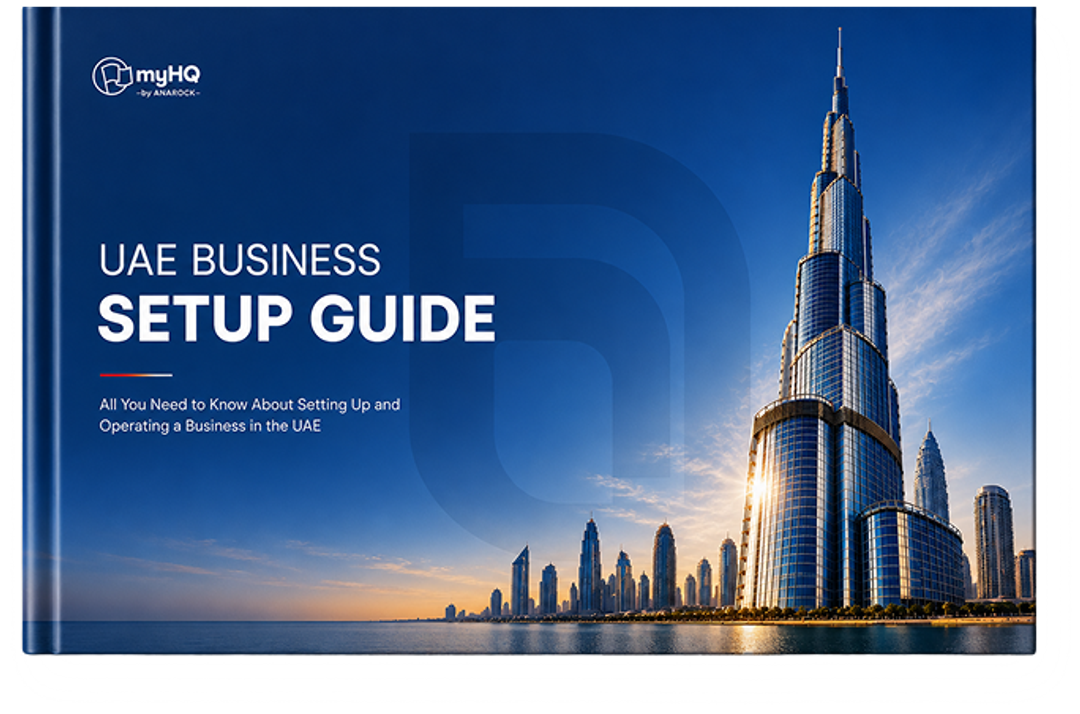
A practical guide covering jurisdictions, licences, costs, visas and the key decisions you need to make before incorporating.
We had a trade name conflict with an existing DET business. myHQ suggested three alternatives the same day and we were approved within 48 hours. The process I thought would take weeks took 3 days.
Priya Singh
Founder of Management Consulting Firm
I set up my IFZA company entirely from Mumbai. Never went to Dubai once. myHQ handled the apostille on my Indian documents, submitted the application, and my licence arrived by courier. Total cost AED 14,500 all-in.
Rahul Mahajan
Runs IT consulting business
I was confused between registering as a freelancer and setting up a company. myHQ walked me through the pros and cons, helped me choose the right structure, and had everything sorted without me having to figure out Dubai regulations on my own.
Ananya Gulati
Content Creator
Every consultant was pushing a different free zone. myHQ actually started by understanding my business, hiring plans, and future goals before recommending the right setup. It saved me from paying for things I didn't need and gave me confidence I was making the right decision.
Karan Gupta
SaaS startup founder
I only wanted to serve international clients and invoice professionally. myHQ recommended a setup that matched my needs instead of the most expensive option. The entire process was transparent, and I always knew what came next.
Neha Bhasin
Corporate Legal Consultant

Talk to a Dubai Mainland setup expert
No fees. No obligations. Just expert advice
Business setup in Dubai mainland means registering a legal entity under the authority of Dubai Economy & Tourism (DET), the government body that issues trade licences in Dubai. DET was formerly known as the Department of Economic Development (DED) before its rebranding in 2021.
The renaming accompanied a significant policy shift. UAE Federal Law No. 32 of 2021, the new UAE Companies Law, abolished the mandatory 51% Emirati shareholder requirement for the vast majority of commercial and professional activities in Dubai. Today, foreign nationals, including Indian founders, can own 100% of a Dubai mainland company for approximately 93% of activities listed in the DET activity registry.
A Dubai mainland company differs fundamentally from a free zone entity. Where a free zone company operates within the boundaries of a designated economic zone and is primarily suited to international trade and services, a DET-licensed mainland company can conduct business anywhere in Dubai and across the UAE. It can hire employees without a visa quota, sign government contracts, open physical retail premises, and establish branches across all seven UAE emirates. The company name, typically an LLC, carries “Dubai” as its registered jurisdiction on every contract, invoice and official document.
DET issues four primary categories of Dubai mainland license:
All Dubai mainland company applications are submitted through the Invest in Dubai (IID) portal, the unified digital gateway for licence applications, trade name reservations, activity amendments and annual renewals. Foreign founders can complete trade name reservation, initial approval, licence application and document upload without being physically present in Dubai. Initial approvals are processed within one to three business days and trade name results within 24–48 hours, and once the licence is issued, a digital copy is available instantly, with a physical card sent by courier.
For Indian founders using a Power of Attorney (PoA) to avoid travelling to Dubai, the PoA authorises a registered PRO or agent, such as myHQ, to represent the applicant before DET and the Dubai Notary Public. The Establishment Card and visa processing sit outside the IID portal and are handled separately through the Ministry of Human Resources and Emiratisation (MOHRE) by the same PRO.
Before Federal Law No. 32 of 2021, almost all mainland companies in Dubai required a UAE national to hold 51% of the shares. The foreign founder controlled the business through side agreements, but the nominal majority stake rested with the Emirati shareholder.
The 2021 law kept the Emirati majority requirement only for a positive list of strategic and impactful activities, maintained by the UAE Ministry of Economy and covering approximately 94 activity categories. All other DET-licensed activities, numbering over 1,900, are open to 100% foreign ownership.
The restricted list includes oil and gas exploration and extraction, electricity and water utilities, telecommunications services, air and maritime transport operations, defence manufacturing, private security services, certain employment agency activities and specific regulated financial services. For these, a UAE national must still hold 51% of shares, though operational control and profit distribution can be structured through a separate shareholders’ agreement to protect the foreign investor’s commercial interests. myHQ maintains a vetted network of UAE national sponsors for restricted activity setups.
The most popular structure for company formation in Dubai mainland is the Limited Liability Company (LLC). An LLC can have between one and fifty shareholders, with liability limited to each shareholder’s share capital contribution, and since 2021 a single foreign national can form one with 100% ownership for most activities.
Every DET mainland licence requires a valid office address registered on the Ejari system; without it, the licence cannot be issued or renewed. There are two routes:
Signing a 12-month lease before the activity and trade name are confirmed is a common and expensive mistake.
Dubai mainland license cost depends mainly on the licence type, but the full Dubai mainland company formation cost also covers the trade name, the MoA and the office.
| Cost Item | Amount (AED) | Notes |
|---|---|---|
| Professional Licence | 5,000–12,000/year | The most affordable mainland licence type |
| Commercial Licence | 8,000–20,000/year | Depends on the number and category of activities |
| Tourism Licence | 8,000–15,000/year | Joint approval from DET and DTCM |
| Industrial Licence | 10,000–25,000/year | Excludes facility costs |
| Trade name reservation | 620 | Via the IID portal |
| MoA drafting and notarisation | 500–2,000 | Inclusive of notary fees |
| Flexi-desk or business centre package | 5,000–8,000/year | Meets the Ejari office requirement |
| Dedicated office lease | 25,000–500,000+/year | Varies significantly by location |
Opening a corporate bank account is typically more straightforward for a mainland company than a free zone one, since an Ejari-registered address and a DET-issued trade licence are both strong KYC anchors for UAE banks. Emirates NBD, Mashreq, ADCB, FAB, RAKBANK and Wio Bank all commonly serve mainland LLCs, with approval taking two to six weeks.
For Indian passport holders, approval rates improve with a UAE residential address and Emirates ID, a clear business plan, a bank introduction letter from myHQ and confirmation of FEMA compliance. RAKBANK and Mashreq have historically been more accommodating of new mainland LLCs from Indian founders than Tier-1 banks such as Emirates NBD and FAB, which typically require six months of operating history first.
Indian resident founders setting up a Dubai DET mainland company must comply with India’s Foreign Exchange Management Act (FEMA) regulations governing Overseas Direct Investment (ODI):
myHQ provides a standard FEMA compliance note to every Indian founder client as part of onboarding, before any fees are paid.
A DET mainland licence must be renewed annually through the IID portal, which sends reminders 90 days before expiry. The office lease must be re-registered on Ejari first, since expired Ejari is the most common cause of delayed renewals. The DET renewal fee is roughly 60–70% of the initial licence fee, since there are no name-reservation or notarisation costs the second time round, and the MOHRE Establishment Card is renewed alongside it. Visa renewals depend on a valid licence and Establishment Card, so an expired licence blocks the whole chain.
Late renewal incurs fines of AED 250–500 per month for the first three months, escalating to AED 1,000–2,000 per month after that.
There is no statutory minimum for most formations. The 2021 Companies Law removed the previous AED 300,000 minimum that applied to LLCs in most sectors, and for most activities a Dubai LLC can be incorporated with nominal share capital of AED 1,000 or more. Regulated sectors, including banking, insurance, healthcare and some financial services, have their own sector-specific requirements.
Yes. If the corporate shareholder is an Indian entity, its board resolution, MoA and Certificate of Incorporation must be notarised and apostilled before submission to DET, and the involvement is subject to FEMA ODI compliance on the Indian side.
The Establishment Card is issued by MOHRE after the trade licence and registers the company with MOHRE. Without it, the company exists but cannot legally employ staff or process residency visas. Visa entitlement has no hard quota: it is determined mainly by office space, at roughly one visa per 80–100 square feet of registered office, with a typical flexi-desk package carrying two to four visa slots.
Yes. Dubai LLCs must maintain proper books of accounts and submit audited financial statements annually, prepared by a UAE-registered auditing firm. With UAE Corporate Tax now in effect, IFRS-compliant books are a regulatory necessity for all mainland entities with taxable income.
DIFC is a financial free zone with its own legal system, courts and authority, designed for financial services and regulated by the DFSA. Most commercial and professional businesses don’t need a DIFC entity: a DET mainland company can instead elect DIFC Courts jurisdiction for commercial disputes, giving it access to common law contract enforcement without being a DIFC entity itself.