Backed by ANAROCK - India’s Largest Real Estate Company
2,000+ happy clients. One trusted partner ⭐
I set up my IFZA company entirely from Mumbai. Never went to Dubai once. myHQ handled the apostille on my Indian documents, submitted the application, and my licence arrived by courier. Total cost AED 14,500 all-in.
RM
Rahul Mahajan
Runs IT consulting business
We had a trade name conflict with an existing DET business. myHQ suggested three alternatives the same day and we were approved within 48 hours. The process I thought would take weeks took 3 days.
PS
Priya Singh
Founder of Management Consulting Firm
I was confused between registering as a freelancer and setting up a company. myHQ walked me through the pros and cons, helped me choose the right structure, and had everything sorted without me having to figure out Dubai regulations on my own.
AG
Ananya Gulati
Content Creator
Every consultant was pushing a different free zone. myHQ actually started by understanding my business, hiring plans, and future goals before recommending the right setup. It saved me from paying for things I didn't need and gave me confidence I was making the right decision.
KG
Karan Gupta
SaaS startup founder
I only wanted to serve international clients and invoice professionally. myHQ recommended a setup that matched my needs instead of the most expensive option. The entire process was transparent, and I always knew what came next.
NB
Neha Bhasin
Corporate Legal Consultant
From DECISION to DONE
Let’s get your DAFZA setup moving
Personalised guidance
End-to-end support
Zero myHQ service fee
Talk to a DAFZA setup expert
Complete your setup with expert guidance tailored for you
Reply in 1 hourNo spam
Frequently Asked Questions
How much does a DAFZA license cost?
A DAFZA license without a visa typically starts around AED 28,000–32,000/year. Adding visa allocation raises the cost — a 1-visa package usually runs AED 34,000–38,000/year, and a 3-visa package with a larger office requirement can reach AED 47,000–55,000/year, depending on activity and office tier.
What companies are registered at DAFZA?
DAFZA hosts a concentrated base of logistics and freight forwarding operators, pharmaceutical distributors, jewelry and precious metals traders, electronics trading companies, and aviation-linked service providers — businesses where proximity to Dubai International Airport's cargo terminal is a genuine operational advantage rather than just an address.
Is DAFZA more expensive than other Dubai free zones?
Yes, generally. DAFZA typically costs more than IFZA, SHAMS, or even DMCC's entry tiers, reflecting its airport-adjacent location and government-authority backing. Founders who don't specifically need air cargo proximity or the prestige of a DAFZA address are often better served by a lower-cost free zone like IFZA.
Can I set up a DAFZA company remotely from India?
Most of the application can be handled remotely through a Power of Attorney, but board resolutions and documents issued from India need apostille — not just notarisation — before submission. Bank account KYC may still require a video call or, in some cases, an in-person visit depending on the bank.
How does DAFZA compare to JAFZA for logistics businesses?
DAFZA suits air cargo and time-sensitive logistics, given its location next to DXB's cargo terminal; JAFZA suits sea freight and heavier industrial trading, given its location next to Jebel Ali Port. Choose based on which mode of freight — air or sea — your business actually depends on.
How many visas can I get with a DAFZA license?
Visa allocation scales with the office package selected — DAFZA packages typically range from no visa up to 3 visas within standard tiers, with larger custom packages available for bigger operations requiring more headcount and a correspondingly larger office space.
Can Indian residents legally hold a DAFZA company?
Yes, subject to standard FEMA disclosure under the Liberalised Remittance Scheme and RBI reporting requirements for overseas direct investment. myHQ includes FEMA flag guidance and RBI notification support as a standard part of every DAFZA engagement, not as a paid add-on.
What is Dubai CommerCity and is it part of DAFZA?
Dubai CommerCity is a dedicated e-commerce free zone developed jointly by DAFZA and Wasl Asset Management. It operates as a distinct e-commerce-focused zone under DAFZA's broader ownership, giving DAFZA-linked founders a specialised e-commerce registration option alongside DAFZA's core logistics and trading focus.
Dubai Airport Free Zone (DAFZA): Company Setup, Licences and Costs (2026)
DAFZA, the Dubai Airport Free Zone, is one of Dubai’s earliest purpose-built free zones, established in 1996 directly adjacent to Dubai International Airport’s cargo terminal. Company formation in Dubai Airport Free Zone differs meaningfully from setting up in a budget-focused free zone like IFZA or SHAMS. DAFZA was never built around being the cheapest entry point into the UAE: it was built around physical proximity to air cargo infrastructure, and its pricing, activity mix and company base reflect that positioning consistently.
The Dubai Airport Free Zone Authority that governs the DAFZA free zone is a government entity, not a private free zone operator. That distinction matters to founders in logistics, pharmaceuticals and high-value trading, sectors where dealing with a government-backed authority (rather than a private company running a free zone as a commercial product) carries real weight with banks, clients and regulators. DAFZA also owns Dubai CommerCity, a dedicated e-commerce free zone developed with Wasl Asset Management, giving it a foothold in digital commerce that most logistics-focused free zones don’t replicate.
What Is DAFZA? Authority and Location
DAFZA (Dubai Airport Free Zone Authority) was established in 1996 in the Al Garhoud area of Dubai, immediately adjacent to Dubai International Airport’s cargo terminal. The authority operates as a government entity under Dubai’s broader economic development framework, distinguishing it from privately operated free zones that function more like commercial real estate products.
DAFZA headquarters and its operational facilities sit within walking distance of DXB’s cargo handling infrastructure, a deliberate design choice rather than an incidental location. The location puts DAFZA-based logistics and freight operators minutes from air cargo handling infrastructure, a genuine operational advantage over free zones located elsewhere in Dubai. Deira and Bur Dubai are a short drive away, and Dubai’s wider road network connects DAFZA efficiently to Jebel Ali Port for businesses that combine air and sea freight in their supply chain.
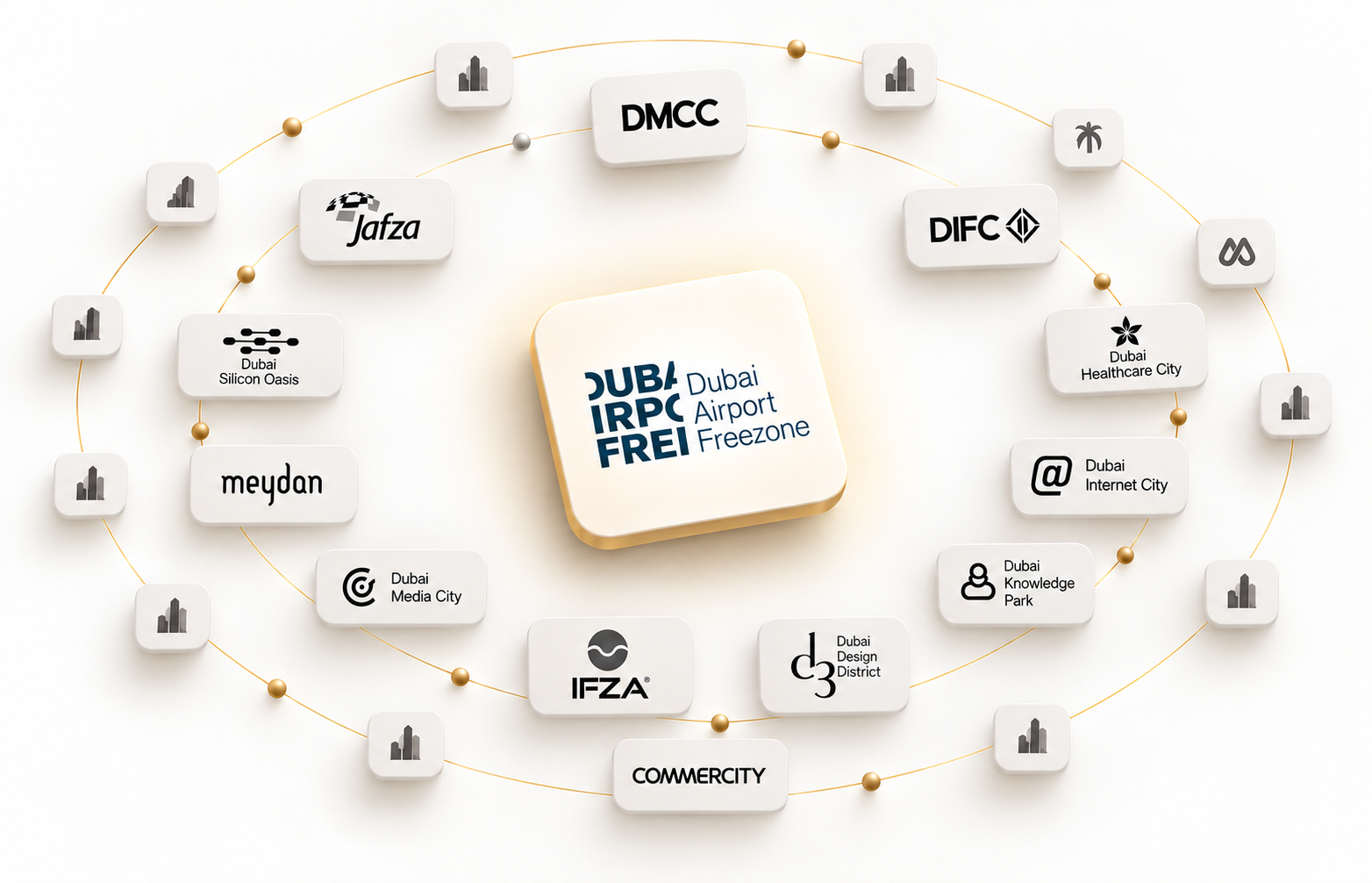
The “airport free zone” name isn’t marketing shorthand. The zone’s entire activity mix, warehouse infrastructure and client base reflect genuine specialisation around aviation-adjacent commerce, distinguishing it clearly from free zones in Dubai built around trading prestige (DMCC), cost efficiency (IFZA, SHAMS) or financial services (DIFC).
Who Should Choose the DAFZA Free Zone
A Dubai Airport Freezone licence suits businesses where air cargo proximity is a genuine operational requirement, not a nice-to-have. Freight forwarding and logistics companies choose DAFZA to minimise the distance between cargo arrival and warehouse processing: every hour saved in transit matters when freight volume and time-sensitivity drive the business model.
Pharmaceutical distributors and healthcare product importers choose DAFZA for similar reasons. Proximity to air cargo minimises the time temperature-sensitive shipments spend in transit between arrival and controlled storage, a factor that matters both operationally and for maintaining the product integrity standards regional health authorities require. Businesses in both sectors should evaluate DAFZA’s warehouse facilities against their actual storage and handling needs before committing to a licence and office tier, since warehouse specification (temperature control, security level, loading dock access) varies across DAFZA’s industrial zone.
Jewellery, precious metals and electronics traders, businesses dealing in high-value, low-volume goods, favour DAFZA’s security infrastructure and established insurance and logistics relationships built around handling valuable cargo. General trading businesses that deal in air-freighted goods (rather than bulk sea-freighted commodities, which favour JAFZA) also find DAFZA well matched to their needs.
DAFZA is a weaker fit for remote-first consultants, e-commerce businesses without physical inventory, or founders whose main decision criterion is minimising annual licence cost. Those businesses are generally better served by IFZA, SHAMS or a comparable budget-focused free zone, since DAFZA’s premium pricing reflects infrastructure and prestige that a purely digital or low-capital business won’t fully use.
DAFZA Activities and Licence Types
DAFZA’s activity list covers four broad licence categories, each mapped to specific business models. Activity approvals lean toward businesses with a genuine physical trade component, a meaningfully different profile from IFZA’s broad 2,000+ activity list, which skews heavily toward services, consulting and digital businesses that need no warehouse or physical goods handling at all.
Trading licence: covers import, export and distribution of specific product categories, including pharmaceuticals, electronics, jewellery and consumer goods, depending on the activity code selected. This is DAFZA’s most commonly issued licence category, reflecting the free zone’s trading-heavy company base.
Service licence: covers consulting, IT and professional service activities. It requires the lowest office commitment among DAFZA’s licence types and suits businesses that want DAFZA’s address and authority backing without warehouse infrastructure.
Industrial licence: covers light manufacturing, assembly and processing work, generally requiring a dedicated warehouse or industrial unit within DAFZA’s facilities rather than a standard flexi-desk arrangement.
General trading licence: permits trading across multiple unrelated product categories under one licence, useful for import and export businesses whose product range spans several of DAFZA’s narrower trading codes.
The choice between the two trading licences matters at registration. A standard trading licence restricts activity to specific product categories defined at registration (for example, electronics or pharmaceuticals), while a general trading licence suits businesses whose product range spans several categories or is likely to expand.
DAFZA Licence Cost (2026): Licence, Visas, Office and Renewal
DAFZA licence cost sits meaningfully above IFZA, SHAMS or RAKEZ’s entry tiers, reflecting its airport-adjacent location and government-authority backing. Adding visa allocation increases cost predictably:
Package
Typical annual cost
No-visa licence
AED 28,000–32,000
1-visa package
AED 34,000–38,000
2-visa package
AED 40,000–46,000
3-visa package (requires a larger office footprint)
AED 47,000–55,000
Costs vary further by activity: industrial licences requiring dedicated warehouse space generally cost more than service licences using a standard office arrangement, given the additional real estate commitment. Optional add-ons (larger warehouse leasing, additional visa allocations beyond the standard tiers, and PRO service retainers) are priced separately and should be itemised upfront rather than bundled into a vague “premium package” quote.
Annual renewal costs are generally close to the initial registration fee, with DAFZA’s audit requirement, more commonly enforced than at some budget free zones, adding a modest recurring compliance cost most founders should plan for from year one. Government fee components can shift independently, so confirm current published rates before budgeting.
How to Register a Company in Dubai Airport Free Zone: Step by Step
DAFZA company formation typically completes in 5–7 working days, from initial activity selection to an active licence, for standard trading and service activities. Industrial licences requiring warehouse allocation can take slightly longer.
Choose your licence and activity. Confirm the specific business activity and match it to the correct DAFZA licence category: trading, service, industrial or general trading. This decision affects both cost and the office or warehouse requirement that follows.
Submit documents to DAFZA. Passport copies, application forms, and – for Indian shareholders – attested or apostilled documents where required, are submitted to DAFZA’s authority desk. Dubai Airport Free Zone company formation applications are generally reviewed efficiently given DAFZA’s established institutional processes, though trading and industrial activities involving physical goods may require additional activity-specific approvals.
Receive your trade licence. On approval, DAFZA issues the trade licence and establishment card, typically within 4–5 working days of document submission for straightforward activities.
Apply for visas and a bank account. With the licence active, investor and employee visa applications can proceed, alongside introduction to banking partners familiar with DAFZA-registered companies.
DAFZA vs JAFZA, DMCC and IFZA
DAFZA vs JAFZA
Both are logistics-oriented free zones in Dubai, but DAFZA specialises in air cargo proximity while JAFZA specialises in sea freight, sitting adjacent to Jebel Ali Port. Choose DAFZA if your supply chain depends on air freight speed; choose JAFZA if you’re moving bulk goods via sea freight or need access to Jebel Ali’s larger industrial land plots.
DAFZA vs DMCC
DMCC positions itself as Dubai’s premier trading and commodities hub, with a broader activity list and higher overall prestige recognition, particularly in commodities and crypto-adjacent trading. DAFZA’s narrower but deeper specialisation in air-freighted goods (pharma, electronics, jewellery) makes it the stronger choice for businesses where physical cargo proximity outweighs DMCC’s broader trading-hub brand recognition.
DAFZA vs IFZA
IFZA is built around cost efficiency and breadth of activity approval, with entry pricing roughly half of DAFZA’s typical starting cost. For remote-first consultants, e-commerce operators or founders with no physical goods to move, IFZA is generally the more rational choice. DAFZA only wins this comparison for businesses that need the airport-adjacent infrastructure IFZA doesn’t offer.
Visas, Banking, Tax and Annual Compliance for DAFZA Companies
Visas. A DAFZA licence enables the standard suite of UAE visa categories. The investor visa is available to shareholders, typically valid for 2 years and renewable alongside the trade licence. Employee visas are tied to the office or warehouse package selected: standard packages range from no visa up to 3 visas, and larger custom packages are available for operations requiring greater headcount and correspondingly larger facilities.
Banking. Emirates NBD, Mashreq, RAKBANK, Wio Bank and ADCB all work with DAFZA-registered companies, though KYC depth varies by specific activity and shareholder nationality. Approval timelines typically run 2–6 weeks, with trading and logistics activities involving higher transaction volumes sometimes taking longer. For Indian passport holders, a formal bank introduction letter outlining business activity, expected transaction profile and DAFZA’s registration status materially improves first-pass approval odds.
Tax. UAE federal corporate tax applies a 9% rate on taxable profit exceeding AED 375,000. DAFZA-registered entities, as free zone companies, can retain a 0% rate on qualifying income provided they meet Qualifying Free Zone Person substance requirements and don’t conduct disqualifying transactions with the UAE mainland. Given DAFZA’s trading-heavy company base, many DAFZA entities cross the AED 375,000 VAT registration threshold faster than a services-only free zone company.
Annual compliance. DAFZA licences require annual renewal on the anniversary of issuance, and DAFZA typically enforces an annual audit requirement as a standard part of its regulations, not an optional add-on. Missing the renewal deadline can result in fines and, in extended cases, licence suspension. Economic Substance Regulations (ESR) assessment is also worth reviewing annually, since certain relevant activities intersect with common DAFZA business models like distribution and headquarters services.
DAFZA for Indian Founders: Apostille, FEMA and DTAA
Indian founders setting up a DAFZA company should plan for the standard apostille requirement on documents issued from India – board resolutions and any Power of Attorney need apostille, not just notarisation, before submission to DAFZA’s authority desk. Most of the application process can proceed remotely, though bank KYC may still require a video call or, in some cases, an in-person visit depending on the specific bank’s risk policy for the business activity involved.
FEMA (Foreign Exchange Management Act) governs how Indian residents may hold and fund a foreign company, including a DAFZA entity, primarily through the Liberalised Remittance Scheme, which currently permits remittance up to USD 250,000 per financial year for permitted transactions including equity investment abroad. RBI reporting for overseas direct investment applies alongside this, and myHQ builds FEMA disclosure guidance and RBI notification support into every DAFZA engagement as standard. The India-UAE Double Taxation Avoidance Agreement (DTAA) governs how dividends and business profits flowing between an Indian tax resident and the DAFZA entity are treated, preventing the same income from being taxed twice.
Why myHQ for DAFZA Company Setup
myHQ is backed by ANAROCK Group and has helped set up more than 10,000 companies across India and the UAE. Our DAFZA engagements run through a direct relationship with DAFZA’s own registered partner desk rather than a layered reseller arrangement, meaning faster application turnaround and a genuine escalation path when a file needs attention at a government-run authority. Every DAFZA quote from myHQ is itemised on Day 1, with licence fee, establishment card, office or warehouse costs and visa processing shown as separate line items. For Indian founders, apostille coordination and FEMA/RBI guidance are included as standard, and our team continues supporting your company past registration – handling annual renewals, the audit process DAFZA requires, banking introductions, and visa renewals so you never have to re-brief a new provider each year.
Frequently Asked Questions About DAFZA
What is a DAFZA companies list and where can I find one?
A DAFZA companies list typically refers to the roster of businesses registered within the free zone, dominated by logistics, freight forwarding, pharmaceutical distribution, jewellery and precious metals trading, and electronics trading companies. It reflects DAFZA’s specialisation around air cargo-adjacent commerce rather than a general SME mix.
How many companies are registered in DAFZA?
DAFZA hosts a substantial and long-established company base built up since 1996, concentrated heavily in logistics, pharma and high-value trading activities rather than the broader SME mix seen at budget-focused free zones. Exact current registration figures should be confirmed directly with DAFZA or myHQ for the latest count.
Is DAFZA good for e-commerce businesses?
DAFZA itself is less commonly chosen for pure e-commerce given its trading and logistics specialisation, but its affiliated Dubai CommerCity zone is purpose-built for e-commerce businesses, offering a more tailored fit than DAFZA’s core trading and service licences.
Can Indians set up a DAFZA company as NRIs?
Yes. Indian residents and NRIs can both hold a DAFZA company. Indian residents must observe FEMA’s Liberalised Remittance Scheme limits and RBI overseas investment reporting requirements; NRIs generally face fewer domestic reporting obligations but should confirm treatment under the India-UAE DTAA for any repatriated income.
Is DAFZA better than the mainland for a logistics business?
It depends on whether the business needs to trade directly within the UAE local market. DAFZA offers lower relative cost than the mainland for a pure export or import operation, plus the air cargo proximity the mainland doesn’t offer, but Dubai mainland wins for businesses needing unrestricted UAE market access or government tender eligibility.










 Most popular

 Most flexible

 World’s #1 Free Zone

 Port Logistics

 Digital First